
Software Alchemy in 2027
Software used to be built once for everyone and owned by whoever paid for the hand coding. In 2026 agentic engineering made code cheap and mixable, and a voice interface I built for Headspace now lives in four other applications. The old ownership framework hasn't kept up, and I'd rather collaborate than fight over it.
Who owns the code?
For most of my career that question answered itself, because software was hard to build and expensive to own. A vendor would gather the requirements of hundreds of customers, find the largest set they had in common, and build that, with every compromise that came with it. The result fitted all of those customers roughly and none of them well. We came to call it software as a service, and the vendor owned it because the vendor had paid for it, line by line, through all the slow microsurgery of building software by hand.
Custom work carried the same weight. In 2025 code was an expensive asset, and the two sides of a software deal fought tooth and nail over who'd walk away owning it. I've heard of AI projects stalling, and some being cancelled outright, because the parties couldn't agree who'd own what.
Call that the old model. It made sense while the code was the costly part.
What changed in 2026?
Agentic software engineering came to the forefront this year, and it changed all the metrics I used to measure a build by. Code stopped being the expensive part.
There's still no consensus in the software community on the right way to build with agents. I've had good results with spec driven development, and even that has been through several iterations as the models and harnesses got better over the year. Some of the rigour stays put, and I expect it always will. The build plan gets checked against the PRD before anything gets built. The build gets checked against the spec before testing starts, then come the unit tests and the integration tests, and every change lands on a tracked branch, through a pull request, into a build queue. Verification is the part I'd never give up.
The tooling underneath is moving too, with at least one model provider now building its own version control system. The method holds while all of that changes around it.
One voice interface, five homes
I built a voice interface for Headspace, my software factory and intelligence platform. It worked well enough that I've since reimplemented it in four other applications, including the agentic platform behind AskNell and Process Monitor, and it's gone in with much success each time.
Each of those is its own piece of software, built for its own purpose, and each carries the same interface inside it, adapted to fit. That's the alchemy in miniature: built once, mixed into many. Under the old model, I'd have had to architect the voice interface for reuse in advance, and that takes considerable design foresight before a line of it is built. Then I'd have had to architect the agentic platform to receive it, which means significant work and compromise, added cost, and integration, with its own compromises, edge cases that need support, and dependencies. A change Headspace needed in the voice interface would ripple into the agentic platform, and on from there.
Run as software alchemy, each one is its own self contained piece of software. They share the same genetic lineage, but a change to a requirement in the Headspace voice interface doesn't touch how the voice interface runs in the agentic platform.
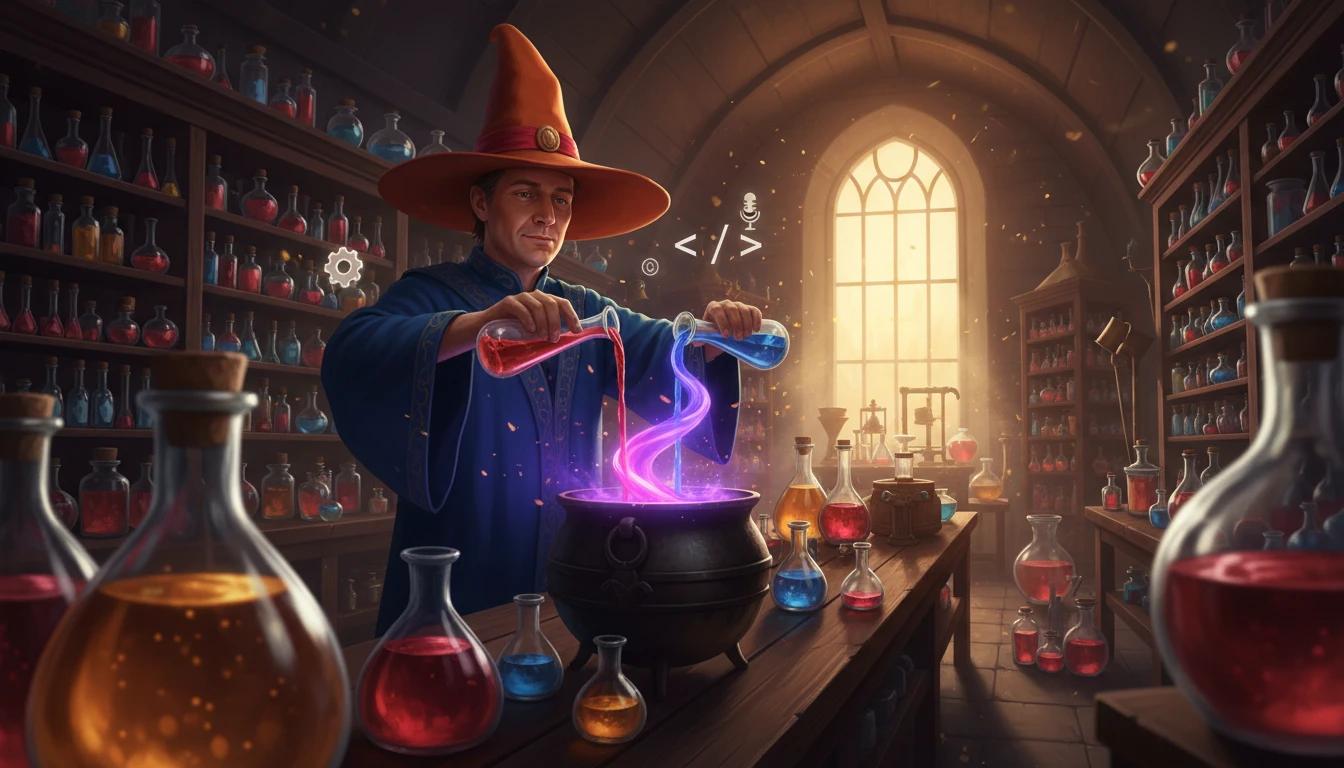
Once it's mixed, it's a new colour
The bigger version happens in discovery. A new customer describes a problem, and partway through I recognise it. I've seen this before, and I've solved it in a particular way. That past solution becomes a component of the workshop, and from there it becomes part of the system I build for them.
Most of what I bring as an engineer is creativity and problem solving. A big part of the tool chest I bring into any engagement is a library of software components, techniques, approaches, and specs, along with the experience of applying them, and one of the newer tools is mixing and matching them into software designed around one business: its requirements, its use cases, its stories, and its operating model. Some of this solution and some of that one, crafted into a new adaptation. The library only pays off if it's free to travel, so I'm not reinventing the wheel every two seconds.
Specs, prompts, instructions, and code get mixed into new compounds. I put it this way in a workshop this week: "once it gets mixed, it's a new colour. You can't unmix." After a few builds the origin of any one piece stops mattering. The only things that have to stay separate are each client's own data and rules, and those stay out by design.
Andrej Karpathy put a version of this out in April, when he shared an idea file in place of code: "in this era of LLM agents, there is less of a point/need of sharing the specific code/app, you just share the idea, then the other person's agent customizes it." The idea travels, and each person's agent builds its own implementation from it.
The law hasn't caught up, and none of this has been tested in production yet. My theory is that the standard framework around software, IP, and ownership is going to have to shift. I don't know what the answer is, and I'm not about to prescribe one.
Building it together
What I want is to collaborate with my customers on the results we're both after, and go on the journey together, because collaboration brings the best outcomes. The old model put the two sides in separate boats, each guarding its own pile of code, and that leads to an outcome that's not so good for either of them.
The software landscape has moved faster than I saw coming. New capabilities are shifting the very foundations of intellectual property and software assets, and some of the questions that used to matter most, like who owns every line of the code, may not even be relevant any more. That's worth saying out loud at the start of any engagement where the goal is to build something interesting together.
I'm still working out what owning software will mean in 2027, as the colours blend and merge in the palette of the software alchemist.