
Mechanics and Realities of Raising Capital
Five founders talked about money with specifics at Stone & Chalk. Product market fit is the gate. Everything else in a raise is downstream of whether the business works.
On Tuesday at Stone & Chalk MLAI ran a brilliant event and did something founders almost never do in public. They talked about money with specifics.
Sonia Kaurah (Tala Thrive / MLAI), Phoebe Gardner (Bardee), Lee Lagdameo (Shikii Labs), Alvin Djajadikerta (Evidentia Labs), and Scotty Allen (The Product Bus) shared insights on their journey and learnings raising capital.
Between them, millions raised, businesses scaled, and a few hard lessons that don't usually make it past the bar conversation afterwards. Dr Sam Donegan called it the single best event on raising capital for founders in Australia. Having sat through a lot of these panels over the years, that tracks.
Here's what stuck with me.
Product market fit is the gate
Every panellist came back to this. Not pitch decks. Not warm intros. Not cap table mechanics. Product market fit. Everything else in a fundraising conversation is downstream of whether the business works.
The panel was unanimous: there is no point walking into a funding conversation without it. One panellist described having 30K in monthly recurring revenue, spending 40K, and knowing they had fit in an emerging market. They raised to capture 95% market share fast, then exit. The capital accelerated something that already worked. It didn't create it.
And the tried and true method of getting there is bootstrapping. Personal funding first, then customer revenue, then proving fit through the grind of selling and delivering. That process is the gate because it forces the work that no amount of external capital can shortcut: figuring out whether anyone will pay for the thing, and learning what they need from it in practice rather than in theory.
I've spent the better part of a year building operational infrastructure for an AI consulting practice before choosing the product direction. That felt slow at times. Hearing the panel talk about bootstrap first, prove fit, then raise made it clear that slow and deliberate is the sequence, not a detour from it.
Valuation is the guiding star
This one was mechanical and I hadn't thought about it this way before. At every funding round, someone is buying a piece of the business at a price. That price implies a total valuation. Back calculate from the number someone would pay, and that becomes the north star for every operational decision between now and the next round.
The rule the panel kept emphasising: valuations only move forward. Accepting a down round is a trap with no clean exit. Every concession on price compounds into the next negotiation. The number on the cap table isn't a formality. It's the single most consequential decision in the raise because every future raise references it.
And what supports the valuation going forward is product market fit generating the numbers to back it. Revenue growing. Retention holding. The valuation moves up because the business underneath it is moving up, and that only happens when fit is proven, not assumed.
The trajectory is the pitch
The panel kept coming back to a pattern that had nothing to do with slide decks. Every investor conversation is a checkpoint. Last time, the founder said they'd do X. This time, they've done X, learned something from it, and now they're doing Y. Next time, Y is done and Z is on the table.
That's not storytelling. That's operational credibility compounding over time.
Product market fit is what generates the trajectory in the first place. It gives the founder real data about what's needed, what works, and where the growth sits. Run rates on the board. Customers paying. Each conversation with an investor references the last, and each one is backed by evidence the business produced by operating, not by projecting.
The confidence that closes a round comes from a real position: this business runs with or without external capital. "I am doing this anyway. Join me or don't." That framing only works when the trajectory is already visible behind it.
The well is easier to poison than to clean
This was the insight that stuck hardest. VCs don't operate in isolation. They rank founders on who introduced them. The introduction itself carries a score before the first conversation even happens. A warm intro from a trusted source opens a door. A cold approach, or worse, a warm intro from someone without credibility in that network, prices the founder down before a word is spoken.
And everything is tracked. What was committed versus what was delivered. VCs share notes across the network. An inconsistency between one conversation and another, a missed milestone that was promised, a pivot that wasn't explained honestly: these compound. One misstep closes doors across an entire ecosystem before the founder even knows it happened.
Honesty about mistakes and pivots is valued. Inconsistency between conversations is fatal. The difference is whether the founder controls the narrative or lets the network construct one from fragments.
Strength is the only negotiating position
Multiple investors at the table keep each other honest. FOMO positioning works because, when done correctly, it reflects a real position: three others in the pipeline, closing date set, the round fills with or without this particular cheque.
But that only holds when there are run rates to point to. Product market fit, again, is what puts the founder in that chair. A founder negotiating from desperation accepts bad terms because bad terms are better than no terms. A founder negotiating from strength walks away from bad terms because the business continues regardless.
The entire conversation kept circling back to the same point. Every advantage in a raise, from valuation positioning to investor behaviour to the ability to walk away, traces back to one condition: the business works before external money arrives.
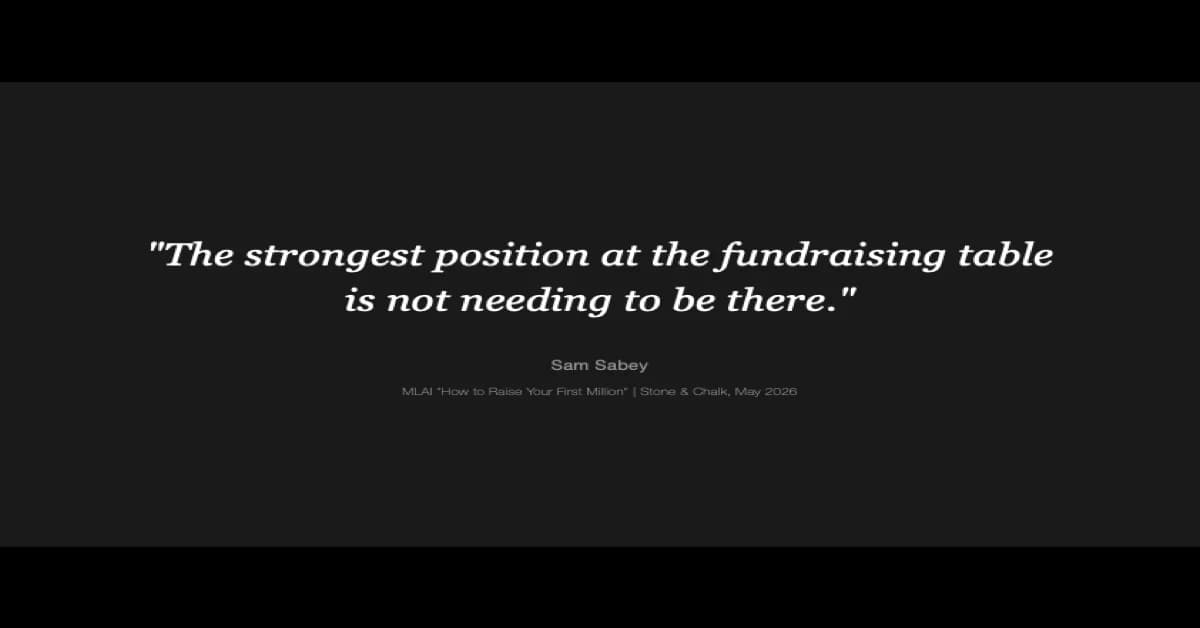
The strongest position at the fundraising table is not needing to be there.