
Behind the scene where AI saved the AI Engineer conference
John Allsopp's conference streaming pipeline broke during a live, oversubscribed event at AI Engineer Melbourne. Claude Code rebuilt it in under two hours, engineering around YouTube's bot detection while John was on stage MCing. A twenty year web veteran's honest reaction to a capability shift measured in months, not years.
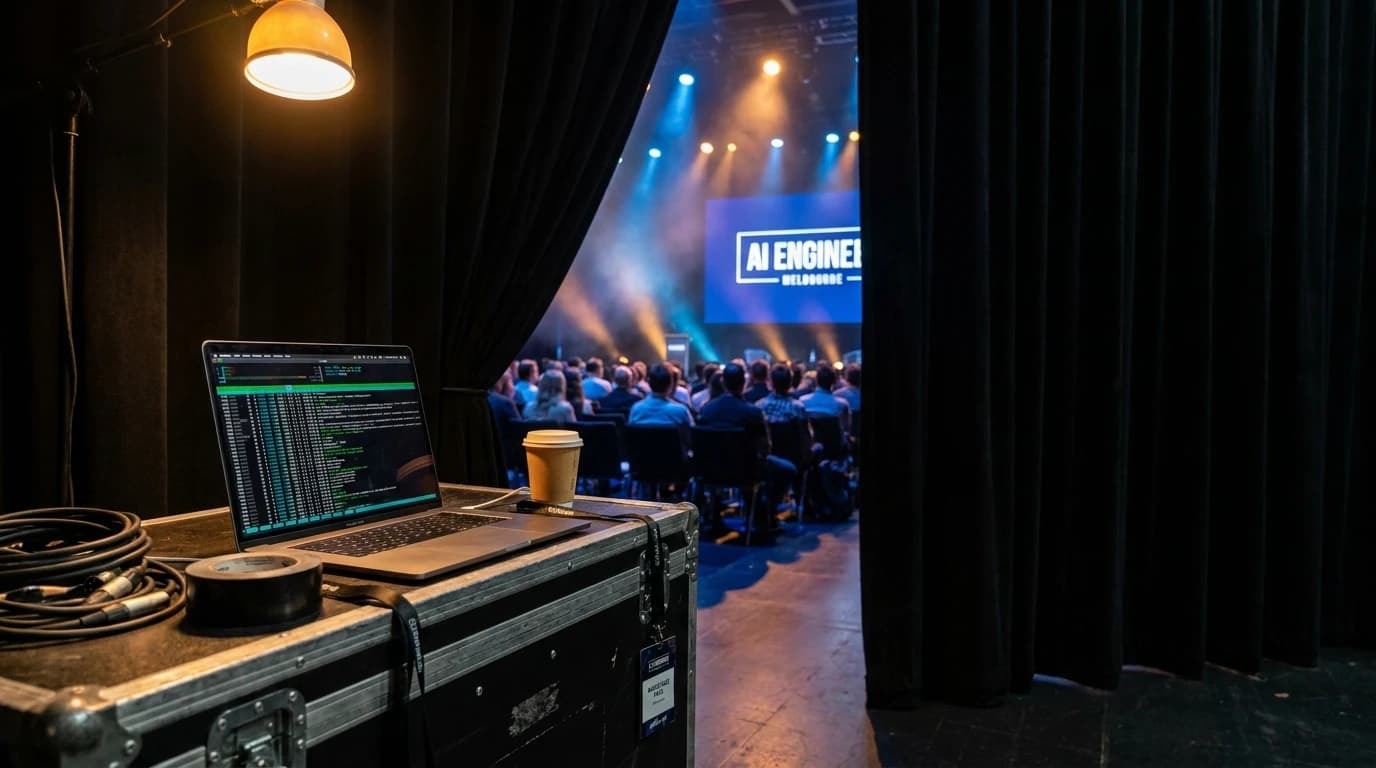
On Friday night I ran into John Allsopp at MLAI after the AI Engineer conference. My voice recorder was running, and it caught a fascinating behind the curtain story.
"Professionally, being left speechless has happened a handful of times in my life, and most of them this year."
John has been running web conferences for over twenty years. He's seen every flavour of tech hype come and go. He doesn't reach for "speechless" casually.
I want to tell the story he told me, because what happened to him on stage the day before is the most concrete example I've encountered of a capability shift that most people still haven't seen up close. Two stories, in fact. The first one sets the scale.
Fifteen minutes and a coffee cup
One of John's conference sponsors needed a redirect URL printed on a coffee cup. Simple problem: destination URL doesn't exist yet, sponsor needs something to print. John went to Bitly. Bitly now wants $10 a month and ownership of the data.
So he pointed Claude Code at the problem. Fifteen minutes later: a complete redirect system with QR code generation (PDF, SVG, PNG, WebP), analytics, custom subdomain creation, and download buttons. All deployed to Cloudflare.
A year ago, that's a weekend project for an experienced developer. Now it's a coffee break for a conference organiser who codes as a second language. That's the baseline for what "normal" looks like now, because the next story makes it look like a rehearsal.
The stream broke
John was MCing his conference when the video streaming pipeline needed to change to allow real time streaming to YouTube, and it needed to happen now. The theatre was oversubscribed. Hundreds of people who couldn't get a seat were counting on the live stream. The whole system was built on Mux's API.
He pointed Claude Code at it. Forty five minutes later, the streaming system was rebuilt to stream to YouTube. Problem solved.
Except it wasn't.
The conference platform still needed the feed. Before the change, it pulled from Mux. Now the stream was going to YouTube, and the platform needed to pull it back down from YouTube instead. Every downstream integration that depended on Mux broke. The fix had created a harder problem than the original. Once upon a time this kind of issue would have been curtains for an idea like this.
And this is where it gets genuinely difficult. YouTube will take a stream going in. Pulling it back out is a different problem entirely. There's no API for it. YouTube actively blocks anything that looks like automated access, and Cloudflare's entire IP range is blacklisted because YouTube treats it all as bot traffic.
Claude Code rebuilt the entire integration layer. It understood the architectural relationship between Mux, YouTube, and the conference platform. It recognised the bot detection constraints and found a path through them, rebuilding every downstream integration to pull from YouTube instead of Mux.
All of this in about an hour. John would stand up, go on stage, MC a session, sit back down, and check progress. Stand up, MC, sit down, check. The conference ran. The audience saw a stream. They had no idea what was happening backstage.
"I can guarantee no human on earth or a team of humans could have done it in ten times the time," he told me. "It wasn't just, oh, here's a simple thing. It's doing system engineering."
He's right. What Claude Code did was system engineering: understanding multiple platforms, working around active countermeasures, and rebuilding integrations across services under time pressure. A problem that would take days even with a team and a proper scope.
Six months
Both problems had fallback options. The stream could have limped along. But Claude Code didn't limp. It "overachieved in a time frame that was unimaginable. A year ago, unimaginable. Probably in December, unimaginable."
That temporal marker is the part I keep coming back to. December. Six months ago. The distance between "impossible" and "done while I was on stage" is measured in months, not years. The person saying it is a conference organiser who threw a problem at a tool out of absolute desperation because his stream was broken and he was supposed to be on stage.
John's framing was better than anything I'd come up with: "When you're not being speechless, you're almost not doing it right. If you're not being speechless, you're not pushing the envelope."
I sat there listening to him, and one thought kept circling: how many people had this experience last week and didn't tell anyone? How many streaming pipelines got rebuilt, how many redirect systems got deployed in fifteen minutes, how many weekend projects became coffee breaks, and nobody wrote it down?
John told me. So I'm writing it down.