
Clag is not the glue to hold your business together
Every business has five systems, three spreadsheets reconciling them, and one person doing copy and paste every morning because nobody else knows which fields go where. The industry named a role for half of this problem. The other half was never written down.
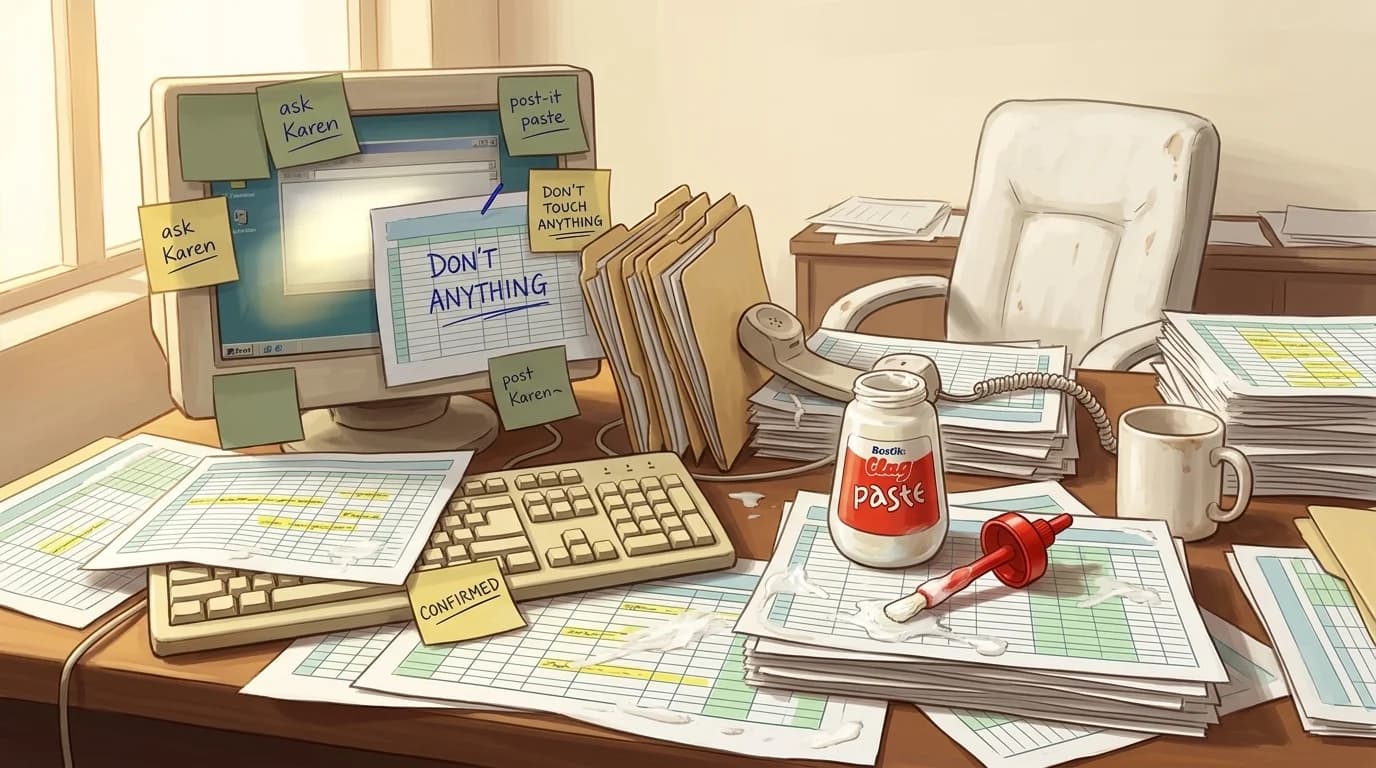
Somewhere in every business there is a meeting where someone says "we should do something with AI." The room nods, someone asks about the data, and that is when the meeting changes.
The data lives in five different systems. Sales and finance calculate the same metric differently, nobody can agree on what "active user" means, and half the workflow still runs in Excel while the other half runs in the heads of three people who have been there long enough to know which workarounds are for a Tuesday vs a Friday. This is the reality of so many businesses today.
It didn't get this way by accident. For decades, businesses have built their systems in silos, and each one arrives with a promise that this will be the system that connects everything, that it will talk to the other systems, that it will give everyone one version of the truth. The business contorts itself to fit whatever the software does, or pays to have it customised as close to the operation as money allows. Six months later, someone builds a spreadsheet to reconcile the numbers that don't match, and then it happens again with the next system, and the next.
The gaps between those systems fill up with paper based workflows, spreadsheets, sticky notes, emails, handwritten notes, and tribal knowledge, peppered with the odd Access database. Interim systems get built to fill gaps somebody meant to close, and some of them have been running for decades, long past the people who built them. One thing I know from Microsoft Excel: the number of bugs grows exponentially in proportion to the number of sheets.
And the glue holding all of it together is copy and paste. A person moving data between two systems by hand, every morning, with no logging, no validation, no owner, and no test. Copy and paste is not an integration point. It is Clag, primary school glue holding together a workflow that outgrew the jar a decade ago, and nobody touches it because the person doing the pasting is the only one who knows which fields go where.
Nobody documented the process because nobody thought of it as a process; they performed it. Open the spreadsheet, copy the numbers, paste them into the other system, and email Karen if column J looks wrong. When someone finally asks "can we automate this?" the honest answer is: automate what, exactly? The process lives in someone's muscle memory, not in a specification.
The industry has noticed the stall and given it a name. The Forward Deployed Engineer sits with the customer, works out what is going wrong, and builds the fix, with discovery and delivery in the same person. OpenAI and Anthropic are hiring for the profile, and that is progress because it names something that matters: the understanding has to travel with the work.
But it patches one seam. The FDE exists because large firms split selling, scoping, building, and running across different people, and the understanding leaks at every handoff. The seller promises a solution to a problem they observed for an hour, the scoper translates that promise into requirements, the builder interprets the requirements, and the runner inherits whatever the builder left behind along with a Confluence page that was last updated six months ago. Four handoffs, four places for the context to bleed out. The FDE is the seat they invented to carry understanding across boundaries the org chart created, which makes it a symptom of scale, not a capability.
The older seam is on the client side, and it is larger. A vendor with split responsibilities walks into a business with split systems, and nobody on either side of that meeting holds the whole picture. The tribal knowledge that makes the operation work was never written down because the people who hold it never thought of it as knowledge. It is not in any of the five systems; it lives in the gaps, in the head of the person doing the pasting, in the sticky note on the monitor, and in the workaround somebody built in 2019 and never documented. The person who knows why the sales report has to run before 7am on the first Tuesday of the month never thought to mention it, because to them it is Tuesday.
The only way to get at all of this is to be in the room from the first conversation, not deployed by a firm with four other people behind the glass but present, from the first sales call through to the system running.
The hardest part was never the technology. It is getting someone to describe the spreadsheet they have been maintaining for eight years, and explain what column J means when it says "ask Karen."