
The electrical revolution didn't happen overnight
Factories took a hundred years to evolve from bolting an electric motor onto the old lineshaft through to flexible CNC machining. The same transformation is happening in knowledge work right now, compressed into months instead of decades. A mechanical engineer's firsthand memory of Holden's engine plant at Fishermans Bend, and why the businesses that will win are the ones willing to clear the floor.
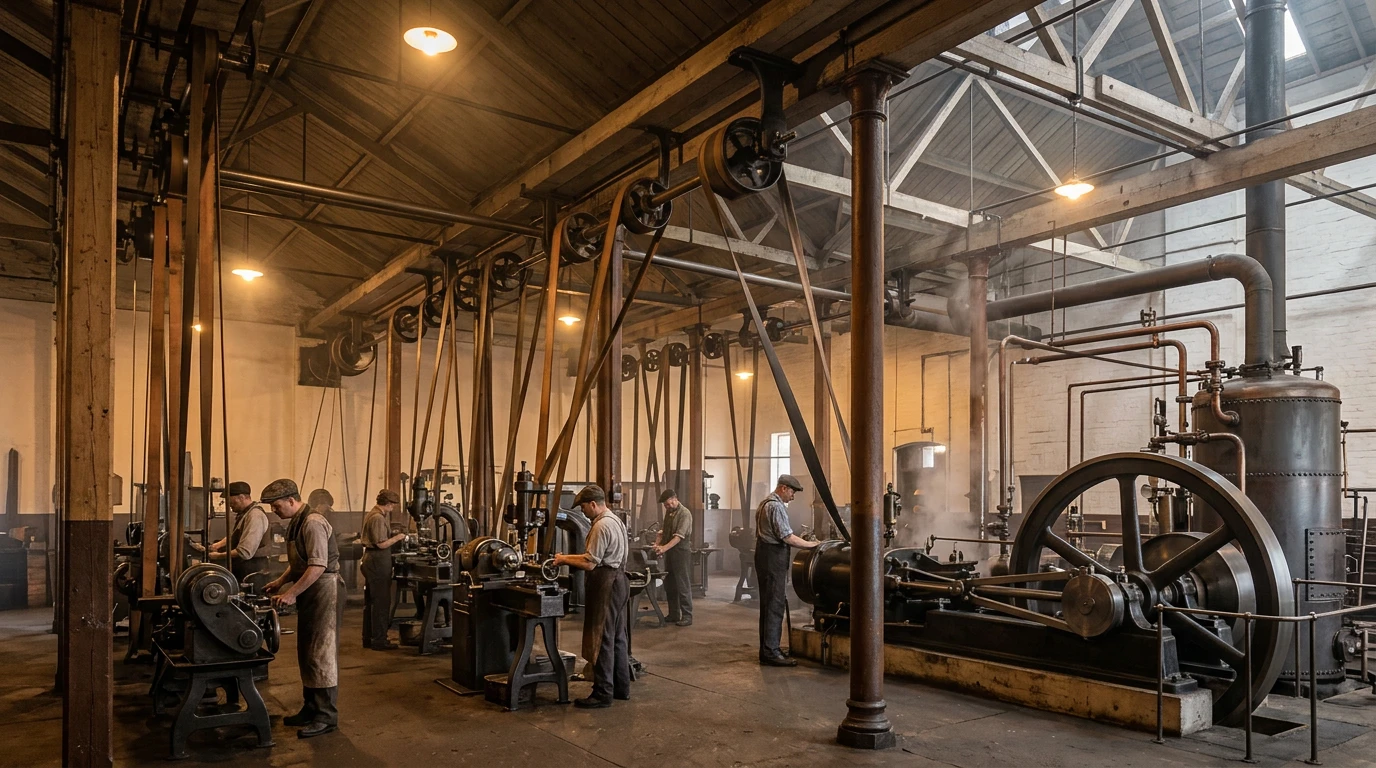
The electrification of manufacturing took a hundred years to transform the factory floor. The same transformation is happening in knowledge work right now, and the clock is running about two hundred times faster.
When electricity first arrived in factories in the late 1890s, owners did the obvious thing. They swapped out the steam engine for a big electric motor driving the same overhead shaft. This used the same line drive power transmission system complete with leather belts driving individual machines on the factory floor. The only change being the line drive was rotated more efficiently by the electric motor.
This went on for decades. Economists would later call it the productivity paradox. Paul David wrote about it in 1990; the technology was available, the gains were real in theory, but the numbers didn't move for nearly twenty years. The architecture around the motor was the bottleneck, and nobody wanted to touch it.
This is where most businesses are with AI right now.
ChatGPT in a browser tab. Copilot in the IDE. An AI assistant bolted onto the same workflows, the same team structures, the same handoffs that existed before any of it arrived. The steam engine is gone but the lineshaft is still spinning.
Faster drafting, quicker research, genuine efficiency gains. But the floor hasn't moved. The work still flows through the same channels it always did, constrained by organisational architecture designed for a world without these tools.
When the motors got small enough
The transformation in manufacturing came when electric motor technology evolved to become small enough to power individual machines.
Once each machine had its own motor, the overhead shaft and belt drive system became redundant. Machines no longer needed to be arranged within reach of the drive shaft. They could be positioned anywhere on the factory floor, arranged around the flow of material through the manufacturing process rather than the physical constraints of the power transmission system.
And the machines themselves evolved. A lathe designed to receive power from an overhead belt is a fundamentally different machine from a lathe with its own integrated motor. Once the power source was built into the machine, the entire design could be rethought around the work it needed to perform rather than how it received its power. New types of machine tools became possible that couldn't have existed under the belt drive system.
This is where AI agents sit in the story. They're the individual machine tools. The drill press, the lathe, the milling machine, each one powered independently, no longer tethered to a central driveline, and able to be positioned wherever the work needs them.
But that reorganisation wasn't free. It meant ripping up the factory floor, running electrical cables to wherever the new machine stations needed power, and pushing through resistance from the people who'd spent their careers working within the constraints of the lineshaft system. The technology was the easy part. The willingness to reorganise was what took decades.
Walking the floor at Fishermans Bend
In the early 1990s when I was studying mechanical engineering I spent six months on secondment at the Holden Engine Company at Fishermans Bend in Port Melbourne. The plant built the Aussie V8, assembled the V6 that powered many a Commodore, and built a four cylinder engine for export to GM's global supply chain feeding Opel and Vauxhall production lines across Europe.
I would spend days exploring that plant.
There were buildings that were essentially single machines, known as transfer machines, and these things were epic. A raw engine block casting went in one end and moved through station after station, each performing a specific machining operation: drilling, boring, surfacing, cleaning. A finished part came out the other end. Entire buildings dedicated to one rigid, sequential manufacturing process. The engineering was extraordinary, but the inflexibility was total.
I remember standing in those transfer line bays watching engine blocks crawl through a sequence of operations that had been designed decades earlier and never changed. Every station bolted in place, every operation fixed in sequence. If the process needed to change, the whole line needed to change. And these lines filled entire buildings.
And the quality problems were baked into the architecture. When one of the hundreds of tools within a transfer line became worn or fell out of alignment, it would affect block after block after block. Sometimes the deviation was enough to scrap an entire production run. Other times the quality deviation was small enough to let through, and those tolerances showed up later as engine failures in vehicles on the road. Many people may remember quality issues with Holden engines from this era, and other manufacturers who relied on transfer machines had the same problem. The transfer machine itself was one of those root causes.
Even back then, Holden were evolving
In one of the large plant buildings a whole bay had been cleared out and something different was happening. Holden were running a project to install a number of Mazak CNC machines in a new production line, Quick Turn lathes with Mazatrol controls, and they'd reworked the entire layout from scratch around the new tooling. One of my projects on secondment was designing material handling equipment for these machines.
The first parts those Mazaks produced were brake rotors machined from fettled castings. Not complex work. The flexible technology started with something straightforward. But what mattered was what it represented. A single machine with multiple axes of tooling that could perform all the operations a section of transfer line did, and then be reprogrammed for the next job.
That image has stayed with me. On one side of the plant, transfer lines filling entire buildings, locked into a single manufacturing process. On the other, a cleared bay and compact machines that could perform the same work and then be reconfigured for a completely different job the next day.
CNC machining continues to evolve today, decades later. That's what happens when the underlying architecture is flexible enough to absorb continuous improvement without being rebuilt from scratch.
The window is closing
From the first electric motor bolted to a factory line shaft through to those Mazak CNC machines cutting brake rotors at Fishermans Bend, nearly a hundred years passed. A century of incremental reorganisation, with twenty years passing before businesses even began adopting electrification seriously, and decades more before the factory floor architecture caught up with what the technology made possible.
In the electrical revolution, a business that took twenty years to reorganise still had competitors moving at the same pace. Six months of AI model releases, capability leaps, and tooling breakthroughs have compressed what feels like thirty years of equivalent technological evolution into a single season. The pattern is the same. The pace is not. And the window to reorganise is closing faster than anyone expects.
Clearing the floor
This is what I build at otageLabs. The CNC equivalent for information work. Flexible systems that can be configured for a task, reprogrammed between jobs, and adapted as the work changes. Tooling that replaces a rigid pipeline with something that evolves.
I walked through Holden's engine plant thirty years ago and watched the tail end of a century of industrial transformation. Transfer lines being supplemented by flexible machines. An entire section of the floor cleared and rebuilt around new capability. The same transition is happening in knowledge work right now, and the businesses that will come out ahead are the ones willing to do what Holden's did in that bay at Fishermans Bend.
The question is the same one factory owners faced a century ago. Are you ready to rework your operations, or are you content to keep bolting a bigger motor onto the same lineshaft?
I'm looking for the ones ready to clear the floor.