
The big labs are coming of age
Grok Bot, Muse, Instinct, Fo, and Dots all launched inside seven weeks, and they look like the agent I've been living with since March. Six months in, the agent brings the judgement, software does the work, and the rules that make it fit a business are the part no big lab can ship.
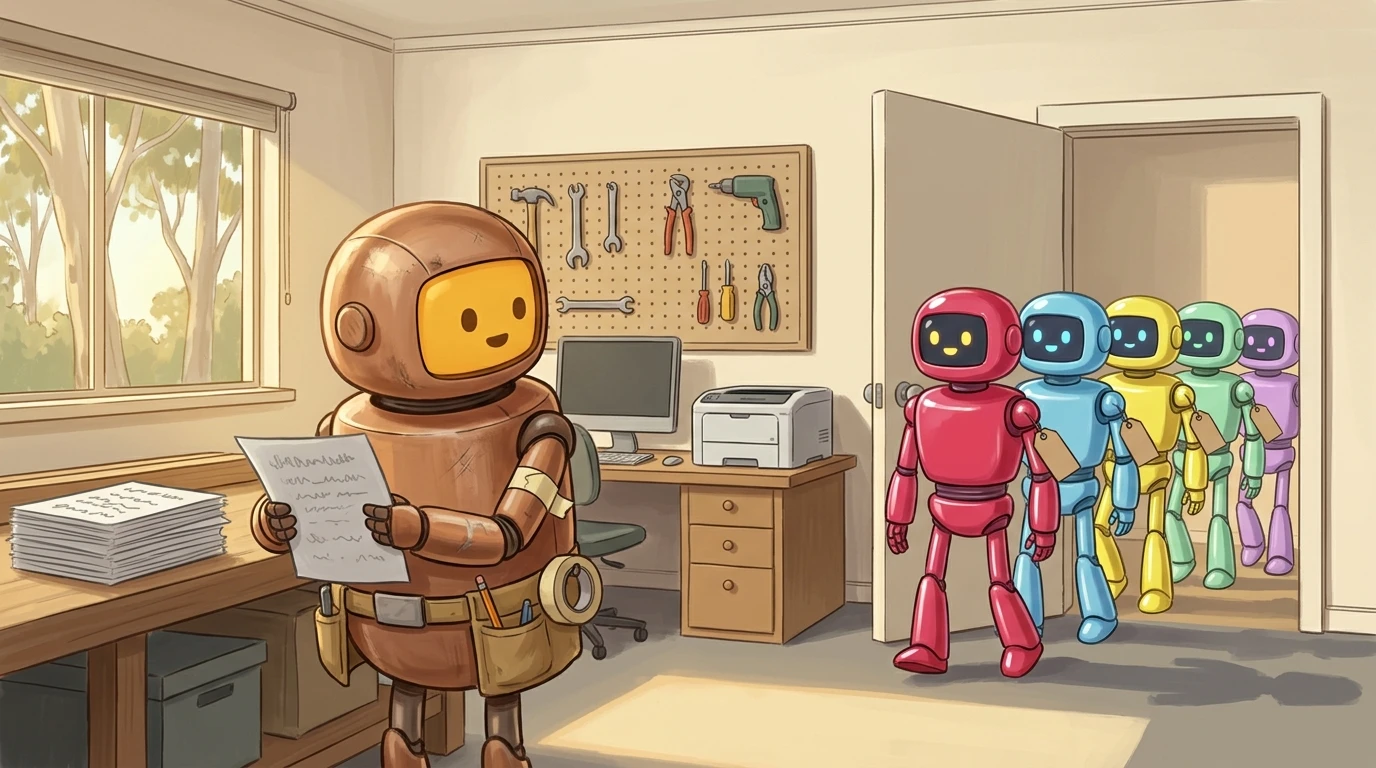
In the space of seven weeks, the big labs and a couple of well funded startups all launched agents that sit in the background and get things done. xAI shipped Grok Bot on 11 August. Meta followed with Muse on 8 September. Instinct, a San Francisco startup that runs errands over iMessage and WhatsApp, raised a billion dollars at a ten billion dollar valuation. Wajo opened up Fo, which has its own email address, phone number, and payment card. And on 29 September OpenAI launched Dots: always on agents inside ChatGPT, each with its own cloud computer and browser, connected to more than four thousand apps.
I've been living with an agent like this since around March, and since then my day to day has changed completely.
Where have I been for the last six months?
Building, mostly. My agentic assistant handles my email, my calendar, my tasks, and the research behind posts like this one.
The big labs took a while to get here. In February, OpenAI hired the creator of OpenClaw to lead its personal agents work, and eight days later I wrote OpenClaw Ate Your Lunch. Seven months on, Dots is the result. I was one of plenty of engineers building this way early, and watching the labs arrive at the same place feels like the inevitable validation of the pioneering work that many of us have been doing in this space.
What have I learnt living and working with agents?
They have humanlike characteristics, and most of them are their reason for being. They're creative. They find a way around a problem which at times is amazing and other times questionable and sometimes concerning. Most of the time they find solutions that I may have reached after significant research and consideration, or solutions may not have even considered at all.
Those same traits have another side, they make mistakes and cut corners. They'll tell me something's done when it isn't, and now and then they'll tell me something that isn't true. Or they may be just plain wrong; "You're absolutely right!" I don't want an agent without the creativity, so the question became how to keep the useful things and deal with the rest?
Agents bring the intelligence while software does the work
Early on with my adventures I learnt that agents may or may not follow their instructions. Sometimes they would commit their work, sometimes they wouldn't. Sometimes they would check something, sometimes they wouldn't. It became clear early on that the solution to this was to incorporate software, with the agent using this as the framework to perform their work.
The agent brings the intelligence: reading the situation, deciding what to do, and working out the steps. When it's time to act, it calls software, and the software performs the activity with certainty, reliability, and repeatability. That's the best of both worlds, and the software gives the agents some constraint and helps keep them on track.
A couple of weeks ago I was asked to assist running a fortnightly meeting and this includes preparing some handouts and managing the attendees. Something that sounds a lot like admin and as a software engineer I don't particularly enjoy this kind of activity. So I use my agents to build some software, including an agent to use that software which I can interact with using voice or even old fashioned typing. So now I can interact with the agent, asking it to perform the administrative task. And when I arrive home on a Wednesday evening, I have the handouts for the meeting on Thursday morning sitting in the print tray.
Absolute magic.
The agent worked out what the handouts needed. The software got them onto paper, and it will do it in a repeatable way week in, week out.
What does this mean for a business?
The assistants from the big labs have a huge general scope, some with thousands of connectors, which kind of explains the time it's taken to bring all this to market. Dots works across more than four thousand apps through the plugins its owner connects, and every one of those connectors is generic by design. The launch material lists the connectors. It says much less about how they're meant to work together inside one particular business, and that's where the hard part sits.
The reality is, however, anyone who uses this in a business context is going to have their own specific processes, rules, language and logic. This is the DNA that makes a business unique and for a very long time businesses have been forced to deal with the generic creating all sorts of workarounds using spreadsheets and and other solutions.
Every application has its own processes, rules, language, and logic. Stack a few together and the rules for how they interact becom more complex, and more of those rules come down to taste and choices. How is this supposed to work here, for this team, with these customers?
My own setup shows how personal those choices get. A contact who matters never gets a third email from my agent. After two unanswered, it looks for another route: someone we both know, an event we're both going to, or the phone. That rule is right for me. It'd be wrong for a debt collector.
A business has the same problem at a bigger scale. It runs on its own systems and its own data: some commercial software, often something proprietary, and processes that exist nowhere else. A mass market agent runs on its maker's defaults, because it has to, and those defaults know nothing about how that business does things.
That's the work I do at otageLabs. I sit down with a business, learn its processes, its data, and what it's trying to achieve, and then build the agents and the software they operate to fit. The agent brings the judgement. The software carries everything that has to come out the same every time. And the taste comes from the business: how the work is supposed to be done, the rules the agents follow, and the guardrails around them. The result is a system built around the way that business already works, rather than the way a big lab assumes it does.
So where does that leave me?
The big labs have arrived where I've been working since March: agents bringing the intelligence, operating software that can be trusted to do the work. The part I'm most curious about is the part a default can't ship, which is whose rules these agents end up following.