
Finding the knack amongst all the tools
A broken car in Metung, a garage full of tools, and no idea where to start. That is what an AI agent session looks like from the inside. The tools exist; the knack for using them does not come installed.
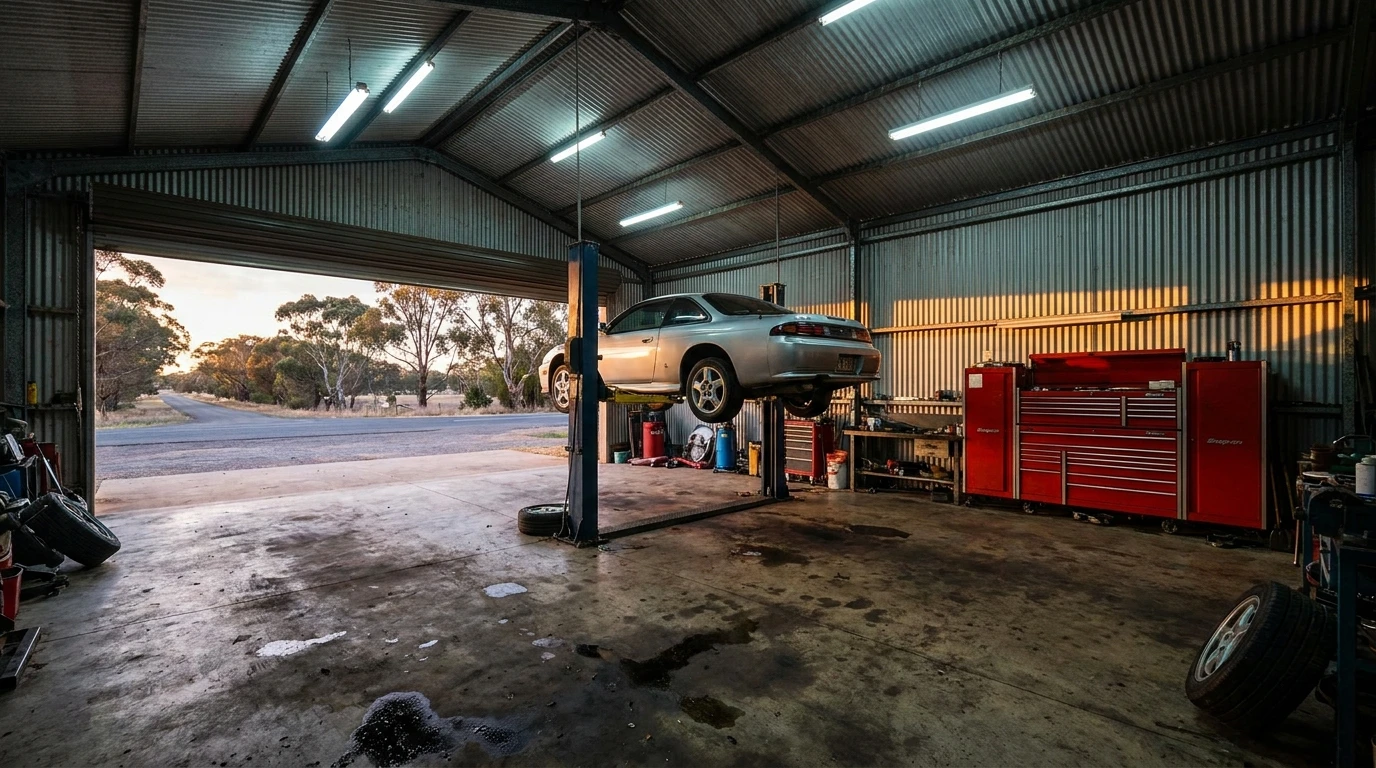
You may be able to relate to this story, or have even experienced something similar.
Once upon a time I was stranded in Metung for what was now entering the third week and I had to get back to Melbourne to see my boys. After three attempts at fixing my car, finally, I'd managed to demonstrate to the mechanics what the real problem was. And to get back on the road the rear brake pads needed to be refit into the new rear calipers. The mechanics had no idea how to do it, neither did I.
So I sat there looking at the problem with the shims in one hand, the pads in another, all I needed to do was figure out how this mechanical jigsaw puzzle fit together. It was late in the day, and it was now dark. And as I stood there looking at it all, I knew there would be a knack, a particular sequence of inserting all the components in a way they would all fit together as the engineers intended and I could get the car back on the ground and be on my way home.
And so I worked the problem. I tried the combinations and eventually the pieces clicked into place and it was solved.
Your AI agent is just like this mechanic faced with a problem, equipped with all the tools, however didn't know the knack or the skill to fit the pieces together.
This is what an AI agent's session looks like from the inside. The drawers are there. The tools are inside. The agent can see every one of them. It has no idea which one to pick up first or what to do with them, let alone understanding or even knowing the problem that they need to solve.
Tools upon tools in the cabinet
In agent terms, each of those big red tool cabinets is an MCP server. Model Context Protocol is how AI agents connect to external tools and services. Open a cabinet, and inside there is a drawer for each capability: read a file, query a database, send a message, search the web. The agent sees the labels. It can technically reach in and grab any of them.
But seeing the label on a 10mm socket is not the same as knowing when to use it. Or knowing that the 10mm is the wrong call for this particular bolt. The car may be a Ford, which requires a universal joint, two extenders in a row, a third universal joint. And a special alignment to even get the tool onto the bolt, which of course uses a Torx head because, Ford.
That sort of knowledge comes from experience. Someone showed the mechanic, who showed the apprentice, who eventually stopped rounding off bolts.
The missing mechanic
That is the gap in most agent setups. The tools exist. MCP servers are everywhere; the open source community has been prolific. There are thousands of them now, covering everything from databases to email to cloud infrastructure. But installing a tool is the equivalent of buying a wrench and putting it in the drawer. The wrench does not know it belongs on the intake manifold, third bolt from the left, quarter turn past finger tight. That knowledge lives in the mechanic.
In agent terms, that knowledge lives in context engineering: skill files, working methods, guardrails, session prompts. The scaffolding that tells an agent what problem it is solving, which tools apply to that problem, how to use each one, and what finished looks like. Building the tool is the easy part.
The grey area
A developer can wire up an MCP server in a day. The grey area, the part that feels closer to craft than engineering, is what comes after.
When does the agent reach for this tool instead of that one? How does it know the database query is the right diagnostic step before the API call, and reversing the order produces garbage? What happens when two tools could both work, but one of them has side effects the agent cannot see?
These are problems a tool description cannot solve. They require the experience and nuance which comes with finding the knack and struggling with the challenge of making all the pieces fit together in the certain order that works.
This is the difference between knowing what a torque wrench does and knowing that this particular bolt, on this particular engine, needs 80 newton metres and then another half turn instead of stopping at the 80nm the manual says, because the bolt requires a specific stress that is not described in the manual.
That kind of knowledge does not come from a package manager. It is the same knack I was looking for in that garage in Metung, shims in one hand and pads in the other, staring at a mechanical jigsaw puzzle in the dark. Fiddling with it. Working the problem until the pieces click into place.
It is the least visible part of the work. And by a wide margin, the part that determines whether the agent fixes the car or strips the bolts and getting home to your kids.