
Hacking the real bottleneck
Everyone's talking about humans being the AI bottleneck. The conversation is all about skills, tooling, and workflow. Nobody's talking about the brain's fuel source, and why Monday was cooked while Tuesday was sharp.
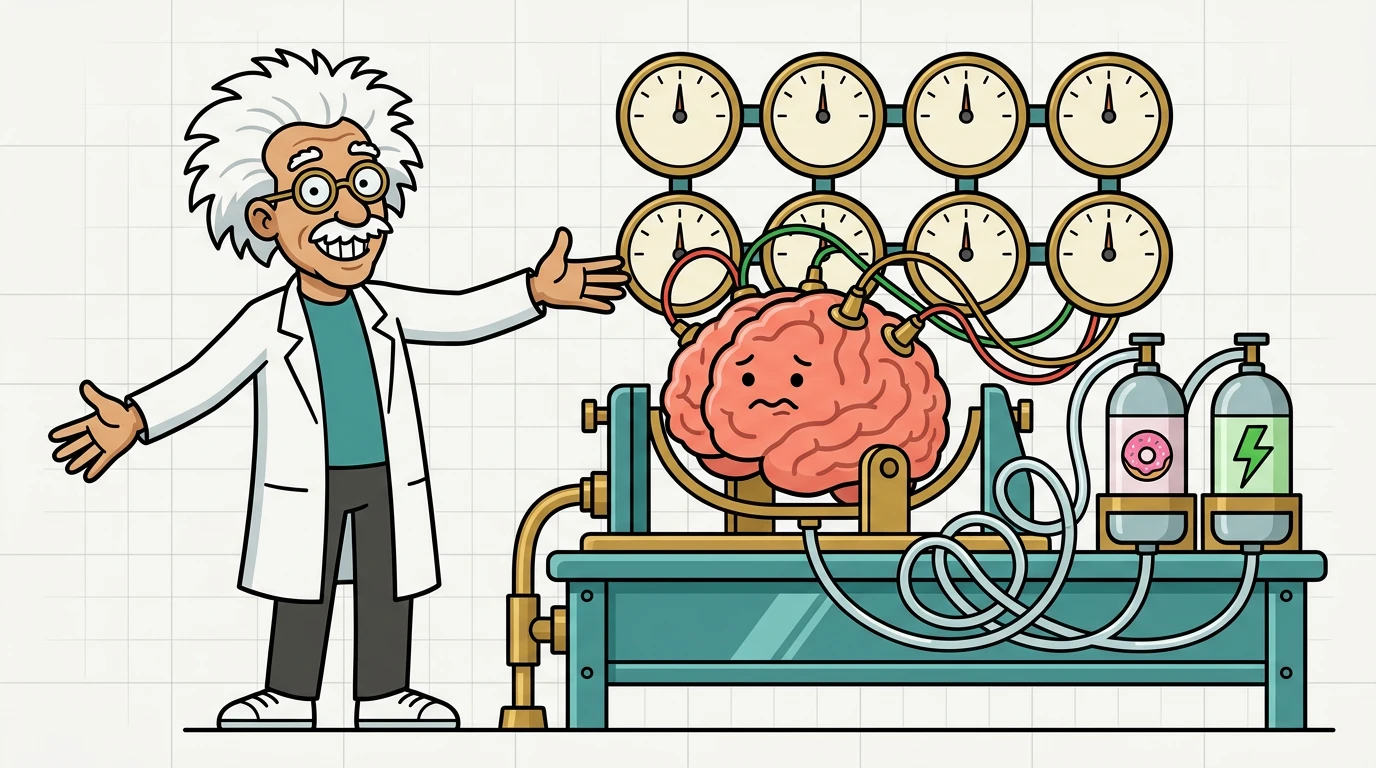
Monday was cooked. I'd loaded up on carbs the day before, fueling a long Sunday ride, and spent the entire workday trying to get words out of my head and into a prompt. The ideas were there. The ability to articulate them was not. I'd start a sentence, lose the thread, start again. The gap between knowing what I wanted and being able to describe it clearly enough for the AI to act on felt like trying to speak underwater.
Tuesday was a different person. Same desk, same project, same tools. I sat down at 5:30am and the words came out clean. Prompts landed first time. The architecture in my head translated to the screen without that grinding friction. The difference was biochemistry.
There's a conversation happening in AI circles right now about humans being the bottleneck. Everyone's focused on the skills gap, learn to prompt, learn the tools, design better workflows. All valid. I'm not hearing much about the physical organ of the meat agent that's doing the work. Our brains.
Our brain is an engine
Engines burn fuel and produce byproducts. When the brain runs on carbohydrates, the primary byproduct is adenosine. Adenosine builds fatigue, fog, and that slow heaviness that makes complex thought feel like pushing through mud. It accumulates across the day, and the cycle feeds on itself; spike, crash, crave more sugar, spike again, crash harder. The craving is the trap. The body asks for exactly the thing that's causing the problem, and it asks louder each time. By early afternoon, the cognitive clarity needed to direct an AI agent has evaporated.
The alternative is switching the fuel source. When the brain runs on ketones instead of glucose, the combustion is cleaner. Less adenosine buildup, more sustained clarity, fewer cravings pulling back toward the vending machine. And here's the thing most people miss; the brain doesn't burn more fuel the harder it thinks. Consumption is roughly constant. The variable is the quality of what's already burning.
When the fog hits
Even on a good fuel day, cognitive fatigue arrives eventually. On a normal day my start is at 5:30am. By afternoon my brain and head are feeling it and I've been hacking this for a while. There are a few resets that work, and they're not all equal.
A power nap works. Twenty minutes, genuinely restorative. Sometimes. Other times it does nothing and the fog is still there when the eyes open. The constraint is practical; not every work context allows someone to close their eyes at 2pm. Lucky for me I have a comfy sofa that's not too far away.
Caffeine works, but it's borrowing from later. Coffee blocks the adenosine receptors so the tiredness stops registering, but the adenosine is still building up behind the dam. When the caffeine wears off, the crash hits harder than if the cup had never happened. Robbing Peter to pay Paul.
Too much in the afternoon brings a second problem; it gets in the way of sleep. And poor sleep compounds the fog into the next day. So the morning cup earns its keep, but the 3pm top up is a loan with bad terms.
Exercise is a lever that I find works almost every time. When I feel the fog rolling in during the afternoon, I get on my bike and head for the trails. The work continues; the venue changes. Something about scenery moving past, elevated heart rate and fresh air genuinely flushes the system. Blood moves, brain opens, and the ability to think clearly comes back within minutes. I've had some of my sharpest technical insights on singletrack with my heart rate at 125, not at a desk staring at a screen. By the time I'm back, the problem I was stuck on has untangled itself.
Fasting is another lever. I'm writing this on the tail end of a 48 hour fast and my brain is running clean. The logic is straightforward; if carbohydrate byproducts cause the fog, removing carbohydrate intake entirely forces the system onto ketones. But 48 hours without food is not for the fainthearted. The hardest part is the carb cravings; getting through the withdrawal wall before the clarity arrives on the other side. Once through, the sustained mental energy is remarkable.
The biohacker's lens
People can eat whatever they want before a deep work session. Maybe some Krispy Kremes are calling. Maybe a Big Mac is exactly the right move for the soul. What I will say is that once I started treating my cognitive performance as a system with tuneable inputs, the quality of my output changed noticeably.
Fuel source is the biggest lever. Movement, sleep quality, fasting windows, flow state conditions; these are the others. Most knowledge workers treat their brain like a black box and hope it performs on demand, and I know this is how I worked for many years. The biohacker's approach is different. Experiment with inputs, observe what happens to outputs, iterate. The same methodology I apply to building software systems, applied to the system running the software engineer.
Working with AI is a cognitive task before it's a technical one. Figuring out the intent, articulating it clearly enough for the system to act on; both collapse when the brain is running on fumes and sugar crash.
Lunch is affecting the next prompt more than which model sits behind it.