
AI Engineer day one: the thoughts I left with
Geoff Huntley's morning keynote at AI Engineer Melbourne compared learning AI to learning guitar. The analogy stuck because everyone in the room was somewhere different on the curve, and the organisational questions it raises are the ones nobody has answered.
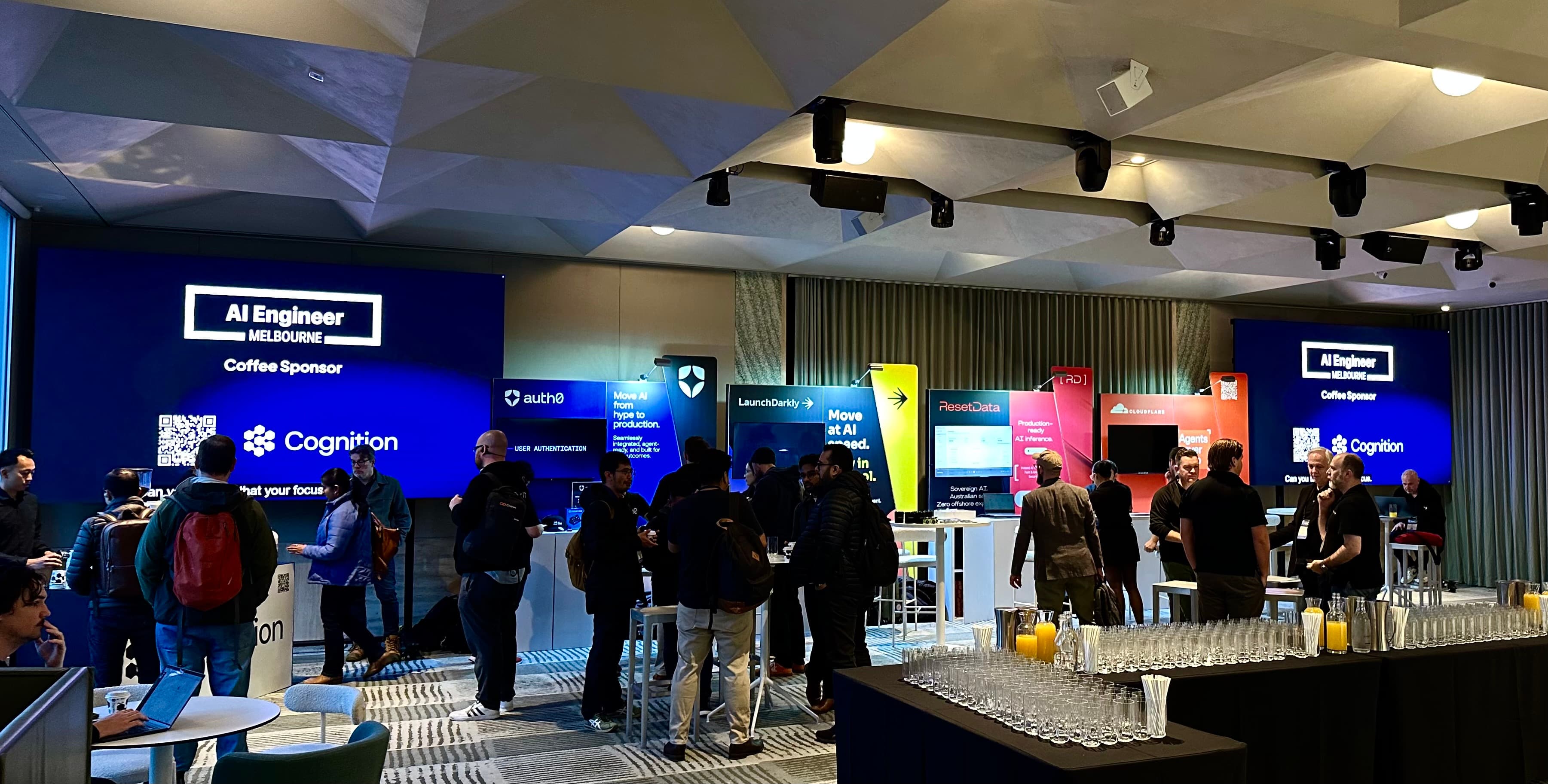
I spent yesterday at AI Engineer Melbourne. Eight hours of talks, hallway conversations, keynotes, and panels across four rooms. The kind of day where every conversation opens a door to something I hadn't considered, and every talk reframes something I thought I understood. I left exhausted, humbled by how much I still don't know, and carrying a thought I can't shake about organisations and musical instruments.
Geoff Huntley, the inventor of the Ralph loop, delivered one of the morning keynotes. He made an analogy that stuck. Learning to use AI is like learning to play a guitar. Nobody picks one up and plays Stairway to Heaven on the first attempt. The thing is out of tune, the fingers don't land where they should, and the sound coming out bears no resemblance to Jimmy Page. Most people experience that, put the guitar down, and conclude that it's just too hard.
But the instrument works fine. It takes practice. Continuous, deliberate, sometimes frustrating practice before the first recognisable chord comes out. Maybe Smoke on the Water after a few sessions if the dedication is there. But the jump from that first power chord to anything resembling fluency takes months of showing up and playing badly.
This maps directly onto what I saw across the conference yesterday. Everyone in the building had genuine interest and investment in AI. The depth of experience varied enormously. People who'd been at it for months and were still finding the edges. People who'd gone so deep into a specific use case that their work would be unrecognisable to a generalist. Everyone falling down their own rabbit hole. The diversity of experience in one room was a fascinating observation on its own, a snapshot of how differently we're all absorbing this rapid, relentless change. New opportunities, new problems, and the shape of work changing and adapting in real time to an intelligence that is, frankly, incredible. And Huntley's other thread, the one that hit harder, laid out the full "oh shit" timeline. Mine hit in December 2025 when I discovered Claude Code, and the realisation landed that software development as a profession has fundamentally shifted. Not ended. Shifted. The constraint moved from writing code to designing, orchestrating, and evaluating what code does. Across the conference, many people had hit the same realisation around the same time.
The guitar analogy resonated because it explains the gap between those different depths of experience. Everyone at the conference has picked up the instrument. Some have been playing scales for eighteen months. Some picked it up last month and are still finding the frets.
The guitar analogy scales beyond individuals. Picture a company with six thousand employees. Everyone knows AI adoption is on the agenda. The board is talking about it. But the ambient message landing from every direction, headlines, restructures, earnings calls, LinkedIn thought leadership, sounds like: "We're going to do more with fewer people."
Nobody has to say it out loud for it to land. People absorb "efficiency and headcount reduction" and are then asked to embrace the instrument that enables it. Learning something new takes vulnerability, and that's almost impossible when it feels threatening. And while many of us are surfing the wave of intense novelty we're experiencing with AI day to day, a lot of people in the same building are experiencing something completely different.
There's a question the industry is wrestling with right now: does AI close the experience gap? Hand a junior the tools and they produce senior output. But a junior with a guitar and an amplifier is still a junior. Louder, with more reach, but the judgement that comes from years of making mistakes and learning what matters is still built the same way it always was.
And then there's the workforce question that kept coming up. Organisations have spent years hiring ahead, building bench strength, backfilling teams to have capacity ready for growth. That playbook assumed the unit of capacity was a person. If the unit of capacity has shifted, those same organisations are carrying teams they built for a future that looks different to the one arriving. They followed the playbook. The playbook changed underneath them. And the people making those workforce calls right now are doing it with incomplete information, under pressure, with no precedent to lean on. There's no obviously correct answer.
Underneath all of this sits a deeper question that nobody at the conference claimed to have answered. Does the classical org chart even make sense anymore?
The tree structure, with its divisions, branches, layers of management, reporting lines, and coordination overhead, was designed for human limitations. Hierarchy exists because humans cannot coordinate at scale without it. Information has to aggregate upward and decisions have to distribute downward because no single person can hold the full picture. Every layer of management is a coordination mechanism for a species that can only hold seven things in working memory.
If AI collapses that coordination cost, the tree isn't too large. It might be the wrong shape entirely.
One of the more provocative ideas floated yesterday was that Block, the company behind Square and Cash App, might be deliberately introducing organisational chaos. The bet: break the existing structure, see where the cards fall, and let the right shape emerge from what self organises around the new capabilities. Controlled chaos as an org design strategy.
Nobody knows if it works. That's the honest position. The organisations that figure out the right shape will figure it out by experimenting, by trying things that feel uncomfortable and seeing what holds.
I walked into yesterday's conference confident in what I've been building. I walked out knowing that the instrument has more strings than I realised, and that I'm somewhere on the same learning curve as everyone else. The difference is the hours logged. And the humility to know there are more hours ahead.
I'm still not sure what the right organisational shape looks like. I suspect nobody is.